Beijing is not trying to rescue the industry. It is trying to stop it from becoming the next solar sector.
China’s energy-storage boom has acquired a new problem: too much optimism.
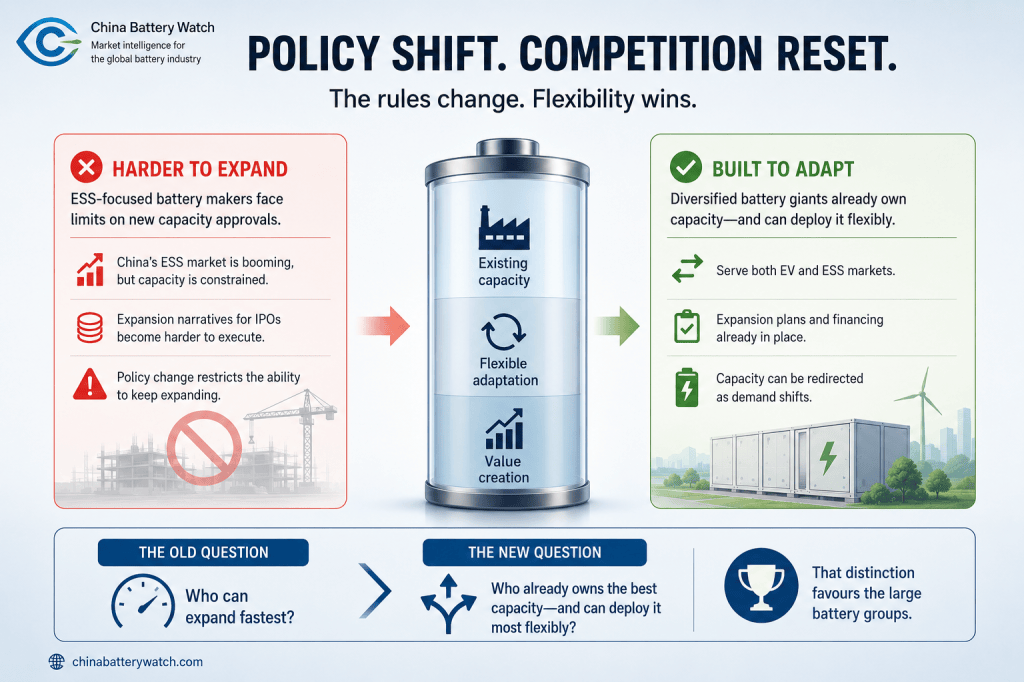
Officials are reportedly reviewing existing and planned production capacity, particularly for battery cells. Projects that remain on paper and have not yet begun construction may face delays, while those already registered and under construction are expected to proceed.
Three words describe the shift: take stock, pause approvals, adjust dynamically.
This is not a bailout. Nor is it a blanket ban on expansion. It is an attempt to prevent a familiar Chinese industrial cycle: booming demand followed by excessive investment and, eventually, a destructive glut.
The irony is that storage itself is doing rather well.
Domestic policy remains supportive, overseas demand is growing and battery makers have reported relatively healthy results. Yet investors are increasingly uneasy. Shares in several storage-related companies have weakened sharply.
The market is not questioning whether storage has a future.
It is asking what happens when everyone decides that it does.
China has seen this film before. During the solar boom of 2020 and 2021, soaring demand encouraged companies to expand aggressively. Capital flooded into the industry. By the time much of the new capacity arrived, supply had overwhelmed demand, triggering collapsing prices and brutal losses.
Storage faces a similar timing problem.
Companies see strong demand today and build factories accordingly. But new capacity takes years to reach the market. By the time it does—perhaps around 2027—demand growth may have slowed while supply accelerates.
That is how shortages become gluts.
The risk is therefore not that energy storage stops growing. It is that capacity grows faster than demand. When that happens, price wars follow. Upstream suppliers, battery makers and downstream integrators all see margins squeezed.
Subsidies can make the problem worse. They stimulate demand, but they also encourage investment. In China, successful industrial policy often attracts more capital than the market can eventually absorb.
That is why Beijing’s intervention matters.
The government is not saying: stop building.
It is saying: find out how much is being built before everyone builds too much.
For investors, that changes the question. The issue is no longer simply whether energy storage will grow.
It probably will.
The more important question is whether profits can survive the growth in capacity.
China’s solar industry offers a sobering answer: a sector can grow rapidly while destroying shareholder value.
Beijing appears determined not to learn that lesson twice.